
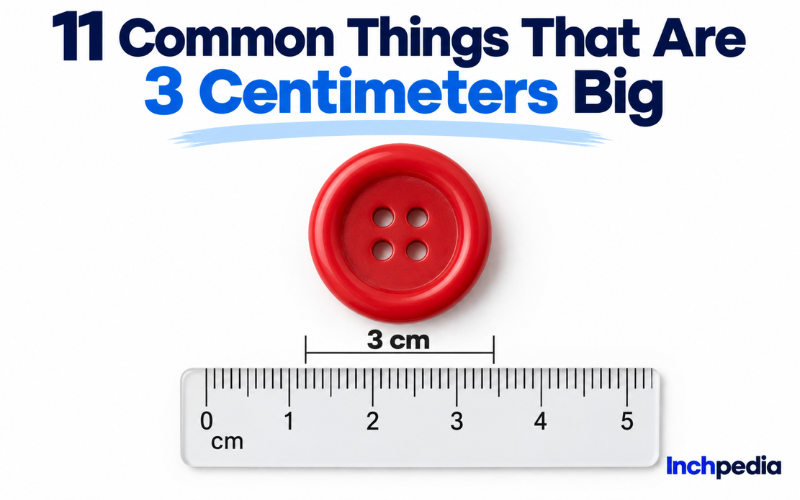
When a measurement is only a few centimeters, it can be hard to tell how large it actually is just by looking at the number. Three centimeters is a small size, but it is slightly longer than one inch, making it a useful measurement for many small everyday objects.
3 centimeters equals 30 millimeters, about 1.18 inches, and 0.03 meters. You may come across this size when looking at buttons, beads, bottle caps, small decorations, stationery, food items, and other compact objects.
If you are asking how big 3 centimeters is, comparing it with ordinary objects is an easy way to get a sense of the size. Below are 11 common things that can be around 3 centimeters big, along with useful conversions and comparisons.
How Long Is 3 Centimeters?
3 Centimeters equals 3 cm or 1.18 inches.
Quick Answer
3 centimeters is equal to 30 millimeters or approximately 1.18 inches.
In simple terms, 3 cm is a little longer than 1 inch.
Some small objects that can be close to 3 cm include:
- Large clothing buttons
- Small bottle caps
- Large craft beads
- Small decorative candles
- Wooden beads
- Small coins
- Cherry tomatoes
- Small walnuts
- Mini erasers
- Decorative magnets
- Small craft pom-poms
These objects come in different sizes, so they are approximate examples rather than exact 3 cm standards.
How Big Is 3 Centimeters?
Three centimeters is a short distance.
On a metric ruler, it runs from the 0 cm mark to the 3 cm mark. Since every centimeter contains 10 millimeters, the calculation is:
3 cm = 30 mm
For an inch conversion:
3 cm ÷ 2.54 = 1.18 inches
So, if you are more familiar with inches, think of 3 cm as slightly more than 1 inch.
A 3 cm object can easily fit between your fingers. Depending on its shape, it may be around the width of a button, the diameter of a bead, or the length of a small stationery item.
How Long Is 3 cm?
A length of 3 cm is approximately 1.18 inches.
Here are some simple comparisons:
- 1 cm is 10 mm.
- 2 cm is 20 mm.
- 3 cm is 30 mm.
- 5 cm is 50 mm.
- 10 cm is 100 mm.
Three centimeters is also 2 cm shorter than 5 cm and 7 cm shorter than 10 cm.
If you have a metric ruler nearby, the 3 cm mark gives you the exact length.
The conversion worth remembering most is:
3 cm ≈ 1.18 inches
For a quick everyday estimate, you can call it a little over 1 inch.
3 cm Compared With Other Measurements
| Measurement | Compared With 3 cm |
| 1 cm | 2 cm shorter |
| 2 cm | 1 cm shorter |
| 3 cm | Same size |
| 4 cm | 1 cm longer |
| 5 cm | 2 cm longer |
| 6 cm | 3 cm longer |
| 10 cm | 7 cm longer |
| 15 cm | 12 cm longer |
| 20 cm | 17 cm longer |
These comparisons are useful when you have a ruler but want to estimate a size quickly.
For example, if you know what 5 cm looks like, a 3 cm measurement is 2 cm shorter.
11 Common Things That Are Around 3 Centimeters Big
| Object | Approximate Size |
| Large clothing button | About 3 cm across |
| Small bottle cap | About 3 cm across |
| Large craft bead | About 3 cm across |
| Small decorative candle | About 3 cm wide |
| Wooden bead | About 3 cm wide |
| Small coin | Around 3 cm across |
| Cherry tomato | Around 3 cm across |
| Small walnut | Around 3 cm wide |
| Mini eraser | Around 3 cm long |
| Decorative magnet | Around 3 cm wide |
| Small craft pom-pom | Around 3 cm across |
The exact size of these objects can differ by brand, design, variety, or type. The measurements are meant as rough everyday comparisons.
1. Large Clothing Button
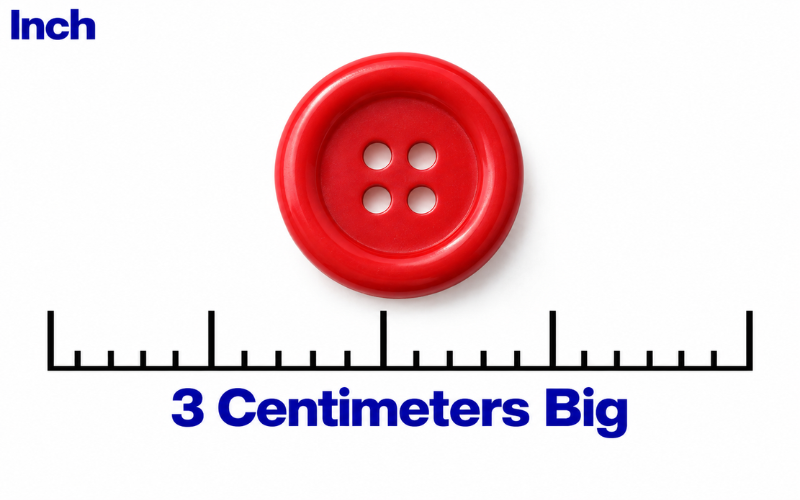
A large clothing button can be close to 3 cm across.
Buttons are made in many different sizes. A button used on a shirt may be less than 2 cm, while larger buttons used on coats, jackets, sweaters, or decorative clothing can be closer to 3 cm.
A round button measuring 3 cm across would have a diameter of approximately 1.18 inches.
If you place the button on a ruler, its widest point would extend across roughly 30 millimeters.
Large buttons are commonly made from plastic, wood, metal, resin, shell, or other materials. Their thickness is usually much less than their width.
For example, a button could measure:
- 3 cm across
- 2.5 mm thick
In this case, the 3 cm measurement refers to the button’s diameter rather than its thickness.
A large button is a convenient reference because it is small enough to hold in your hand while still being noticeably larger than many standard shirt buttons.
If a sewing pattern or craft project calls for a 30 mm button, that is the same as a 3 cm button.
30 mm = 3 cm
This makes button sizes a useful way to compare metric measurements with objects you may already have at home.
2. Small Bottle Cap
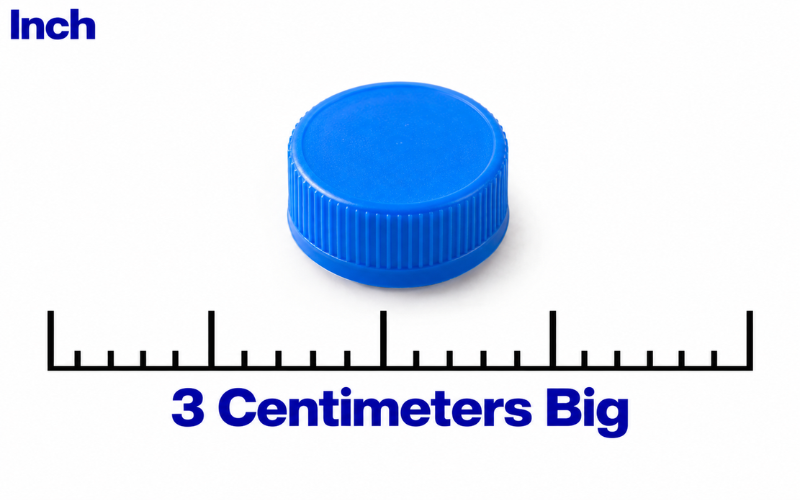
A small bottle cap can also be close to 3 cm in diameter.
Bottle caps are not all the same size. Their dimensions depend on the bottle and closure design. Some are quite narrow, while others are wider.
A cap measuring approximately 3 cm across would be about 1.18 inches wide.
For a round cap, the measurement usually refers to its diameter—the distance from one side through the center to the opposite side.
The height of the cap can be much smaller than its diameter.
For example, a cap might be approximately:
3 cm wide × 1 cm tall
So when using a bottle cap as a 3 cm comparison, the important measurement is its width.
Bottle caps are useful because they have a simple circular shape. You can place one next to a ruler and check how close its diameter is to the 3 cm mark.
If you have several types of bottle caps at home, you may notice that some are smaller or larger than 3 cm. This is a good example of why everyday objects should be treated as approximate references.
3. Large Craft Bead
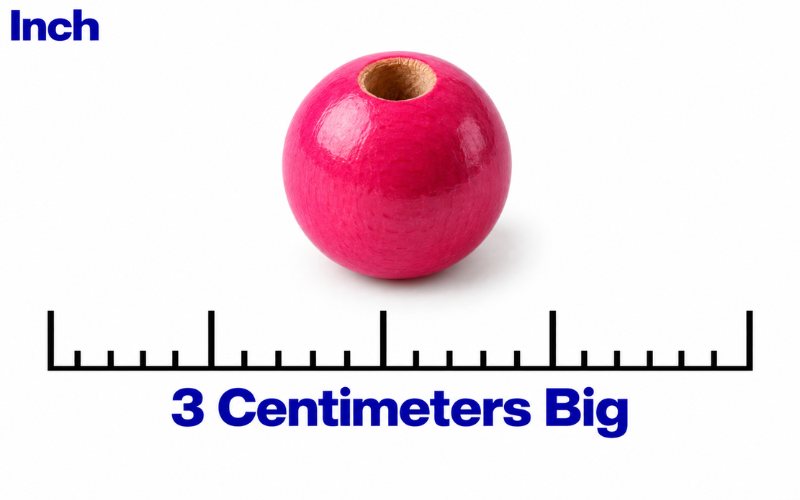
A large craft bead can have a diameter of approximately 3 cm.
Beads are available in many sizes. Tiny jewelry beads may be only a few millimeters wide, while decorative craft beads can be several centimeters across.
A round bead that measures 3 cm in diameter is approximately 1.18 inches wide.
This is a fairly noticeable size for a bead, particularly when compared with small beads commonly used for bracelets and necklaces.
Large craft beads may be made from:
- Wood
- Plastic
- Glass
- Ceramic
- Acrylic
- Resin
The shape also affects how the measurement is described.
A round bead may be 3 cm in diameter, while an oval bead could be 3 cm long and only 2 cm wide.
Therefore, when shopping for beads, check whether the listed measurement refers to length, width, height, or diameter.
For craft projects, 3 cm is also useful to remember as 30 mm. Some suppliers list bead sizes in millimeters instead of centimeters.
So if you see a bead described as 30 mm, you know that it is 3 cm.
4. Small Decorative Candle
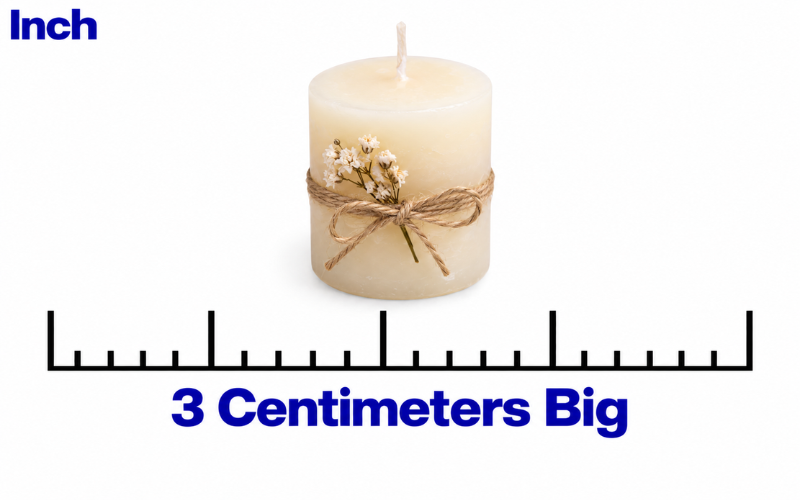
A small decorative candle can have a width or diameter close to 3 cm.
Candles are produced in a wide range of shapes. Some are tall and narrow, while others are short and wide.
A small cylindrical candle with a diameter of 3 cm would be approximately 1.18 inches wide.
If you looked at the candle from above, the circular top would measure about 3 cm from one side to the other.
The height could be completely different.
For example, a candle could be:
3 cm in diameter and 7 cm tall.
This shows why it is important to know which part of an object a measurement describes.
A 3 cm candle width is relatively small and can fit comfortably in a compact decorative holder.
Small candles used for decorations, crafts, party displays, or miniature arrangements can sometimes have dimensions close to this size.
The exact size depends on the candle style, so a ruler should be used if you need an accurate measurement.
5. Wooden Bead
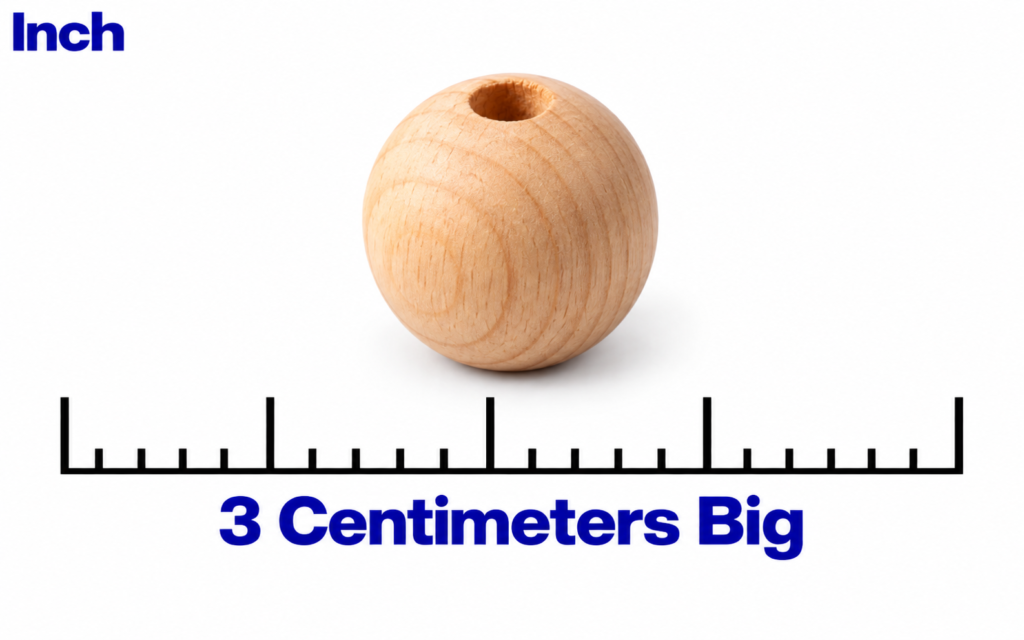
A wooden bead around 3 cm wide is another simple example.
Wooden beads are commonly used in handmade decorations, jewelry, garlands, ornaments, toys, and craft projects.
A round wooden bead with a diameter of approximately 3 cm would be just over 1 inch wide.
Its size would be noticeably larger than many small jewelry beads, but it would still fit easily in the palm of your hand.
Wooden beads are available in several shapes, including:
- Round
- Oval
- Barrel-shaped
- Square
- Flat
- Faceted
A round bead makes the easiest comparison because its diameter can be measured directly across its center.
A 3 cm wooden bead may also be described by a seller as a 30 mm wooden bead.
These are exactly the same measurement:
3 cm = 30 mm
If you are working on a craft project, knowing both terms can make it easier to find the correct size.
6. Small Coin
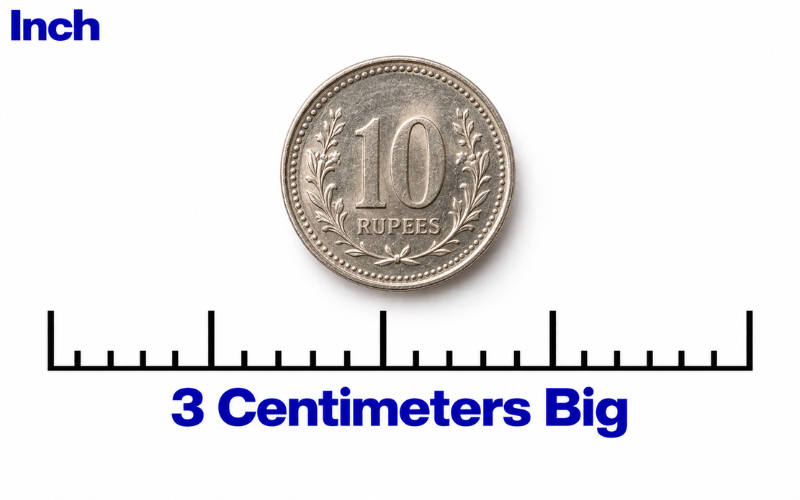
Some small coins can be close to 3 cm in diameter.
Coin sizes vary from one country and denomination to another, so there is no single coin that should be considered an exact 3 cm standard.
However, a coin measuring approximately 30 mm across provides a familiar reference.
The diameter is measured from one edge of the coin through its center to the opposite edge.
A 3 cm coin would be:
30 mm across
or approximately:
1.18 inches across
Coins are useful for size comparisons because their dimensions are generally consistent within a specific denomination.
If you have several coins available, placing them next to a ruler can show how much their sizes differ.
Some coins may be close to 2 cm, while others may be around 2.5 cm, 3 cm, or larger.
Therefore, always check the actual dimensions if you need an exact comparison.
7. Cherry Tomato
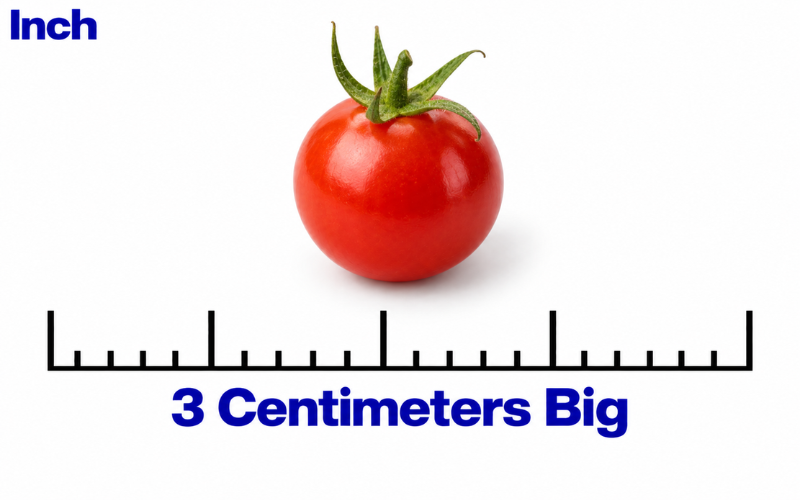
A cherry tomato can sometimes measure close to 3 cm across.
Because tomatoes are natural products, their dimensions vary. Some cherry tomatoes are quite small, while others are larger and may have a slightly oval shape.
A tomato around 3 cm across provides an easy kitchen reference for this measurement.
If the tomato is round, its widest point may be close to 3 cm.
You can measure it by placing it beside a ruler and checking its maximum width.
A cherry tomato is also a good example of why “3 cm big” does not necessarily mean that every part of an object measures 3 cm.
For example, an oval tomato might be:
- 3 cm long
- 2.5 cm wide
- 2.5 cm tall
Its overall size is therefore close to 3 cm, but the dimensions are not identical.
Natural foods are useful for rough comparisons, but they should not be used when an exact measurement is required.
8. Small Walnut
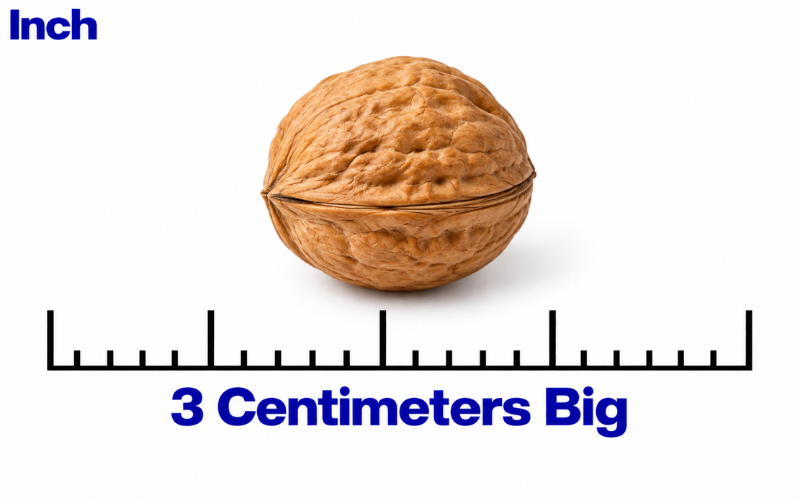
A small walnut can be roughly 3 cm wide.
Walnuts are naturally irregular, so their measurements are not uniform. One walnut can be slightly smaller or larger than another.
A small walnut may have a maximum width close to 3 cm.
Because of its irregular shape, the measurement could refer to its widest point rather than a straight, consistent dimension.
For an object like a walnut, you might measure:
- Overall length
- Widest point
- Height
- Thickness
If someone says a walnut is about 3 cm big, they are generally giving an approximate size rather than saying every dimension is exactly 3 cm.
This makes the walnut a useful example for everyday estimation, but not for precision work.
A ruler can quickly show whether a particular walnut is near 3 cm.
9. Mini Eraser
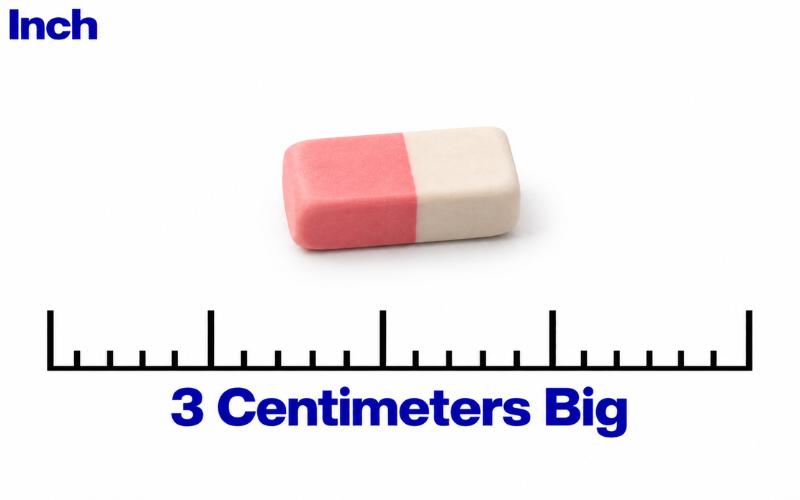
A mini eraser can be around 3 cm long.
Small erasers are available in many shapes and sizes. Some are designed to fit on the end of a pencil, while others are separate rectangular blocks.
A small rectangular eraser measuring about 3 cm long would be approximately 1.18 inches long.
Erasers are especially easy to measure because many have straight edges.
Place one end at the 0 cm mark on a ruler and check where the opposite end falls. If it reaches the 3 cm mark, its length is exactly 3 cm.
A mini eraser may have dimensions such as:
3 cm × 1.5 cm × 0.8 cm
In that example, only its length is 3 cm.
This is another reminder that an object’s overall size depends on its length, width, and height.
10. Small Decorative Magnet
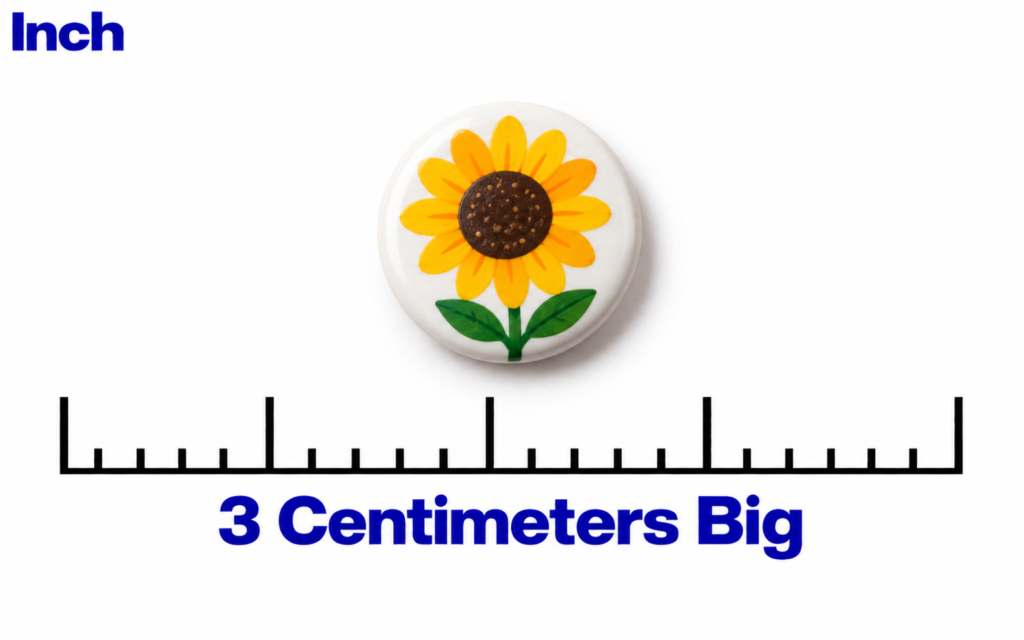
A small decorative magnet can be approximately 3 cm wide.
Magnets used on refrigerators, whiteboards, filing cabinets, and other metal surfaces come in many designs.
You may find magnets shaped like:
- Circles
- Squares
- Stars
- Flowers
- Animals
- Letters
- Food
- Simple geometric shapes
A small round magnet measuring 3 cm in diameter would be approximately 1.18 inches across.
If the magnet is square, its side could measure around 3 cm.
The design does not matter as much as the dimension being measured.
A 3 cm magnet is small enough to fit comfortably in your hand but large enough to be easily seen.
Because decorative magnets are common household objects, they can serve as a practical reference when thinking about the size of 3 cm.
11. Small Craft Pom-Pom
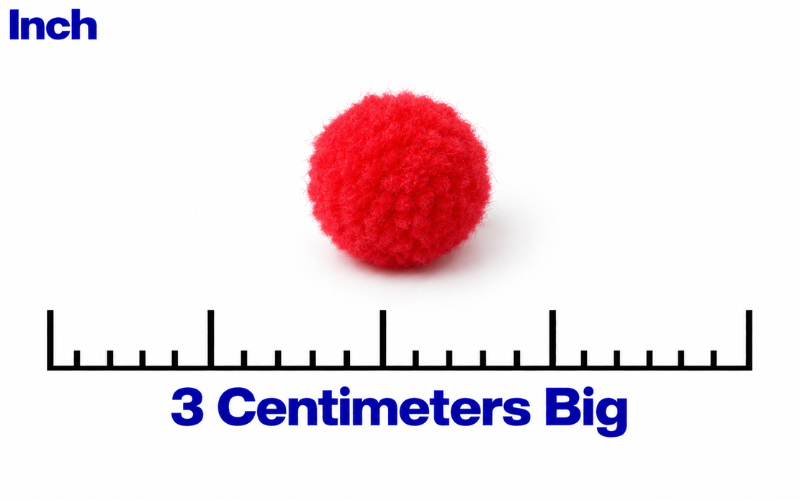
A small craft pom-pom can measure approximately 3 cm across.
Pom-poms are popular for school projects, decorations, handmade cards, ornaments, and other craft activities.
They come in many sizes, so a small pom-pom may be only a few millimeters wide while a larger one can be several centimeters across.
A pom-pom around 3 cm in diameter is a little longer than 1 inch.
Unlike a solid object, a pom-pom is soft and fluffy. Pressing it can change its apparent size, which means measurements may vary depending on how it is handled.
For this reason, a 3 cm pom-pom should be considered an approximate reference.
Still, it provides a simple example of something small enough to fit between your fingers while being slightly larger than an inch.
Why 3 cm Is Useful in Everyday Measurements
Small measurements appear more often than you might expect.
You may see centimeters used when buying:
- Craft supplies
- Jewelry
- Buttons
- Decorations
- Small toys
- Stationery
- Kitchen accessories
- Phone accessories
- Collectibles
- Household items
A product description may say that an item is 3 cm wide, but if you normally use inches, the number may not immediately tell you how large the item will be.
Knowing that 3 cm is approximately 1.18 inches gives you a much quicker reference.
It also helps when comparing products from different manufacturers.
Is 3 cm Big or Small?
3 cm is a small measurement.
It is slightly longer than one inch and is suitable for describing many compact objects.
For a large piece of furniture, 3 cm would be tiny.
For a button, bead, magnet, or small food item, 3 cm can be a noticeable size.
For example:
- A 3 cm button is relatively small.
- A 3 cm bead is a medium-to-large craft bead.
- A 3 cm magnet is compact.
- A 3 cm cherry tomato is fairly small.
- A 3 cm eraser is short.
The answer depends on what is being measured.
3 cm Compared With a Finger
Some people use their fingers as a quick size reference.
A 3 cm distance can be compared with a small portion of the width or length of a fingertip, but this is not a reliable measuring method.
Hand sizes differ between people.
For a rough estimate, your finger may help you picture the distance. For anything requiring accuracy, use a ruler.
A simple way to remember the measurement is:
3 cm is slightly longer than 1 inch.
That comparison is more reliable than using your hand.
3 cm Compared With 1 Inch
One inch equals 2.54 cm.
Therefore, 3 cm is:
3 − 2.54 = 0.46 cm
longer than one inch.
In inches:
3 cm ≈ 1.18 inches
So, 3 cm is close to 1 inch but not exactly equal to it.
This difference becomes more important when you are measuring small objects where a few millimeters can affect whether something fits.
3 cm Compared With 2 cm
A 3 cm measurement is exactly 1 cm longer than 2 cm.
The calculation is simple:
3 cm − 2 cm = 1 cm
A 3 cm object is therefore one and a half times the length of a 2 cm object.
For small items such as beads or buttons, this difference can be quite noticeable.
3 cm Compared With 4 cm
A 4 cm measurement is exactly 1 cm longer than 3 cm.
So:
4 cm − 3 cm = 1 cm
Although 1 cm may seem like a small difference, it represents one-third of a 3 cm measurement.
That can make a noticeable difference when comparing small products.
3 cm Compared With 5 cm
Five centimeters is 2 cm longer than 3 cm.
The calculation is:
5 − 3 = 2 cm
Three centimeters therefore represents 60% of 5 cm.
If you have a ruler, compare the 3 cm and 5 cm marks. The distance between them is exactly 2 cm.
3 cm Compared With 10 cm
Ten centimeters is considerably longer than 3 cm.
The difference is:
10 − 3 = 7 cm
Three 3 cm sections equal:
3 × 3 = 9 cm
So three objects that are each exactly 3 cm long would reach 9 cm when placed end to end.
You would need another 1 cm to reach 10 cm.
This is a simple way to compare a small 3 cm measurement with a more familiar 10 cm length.
3 cm Compared With 15 cm
Fifteen centimeters is exactly five times 3 cm.
3 × 5 = 15 cm
So five 3 cm sections placed end to end would make a total length of 15 cm.
This is useful when comparing 3 cm with a short ruler or another object measuring around 15 cm.
A single 3 cm object would occupy only one-fifth of that distance.
3 cm Compared With 20 cm
Twenty centimeters is much longer than 3 cm.
The difference is:
20 − 3 = 17 cm
You would need six full 3 cm sections to reach 18 cm, which is slightly shorter than 20 cm.
This shows how quickly a few-centimeter measurement becomes small when compared with longer everyday objects.
How to Measure 3 cm Correctly
If you need to check whether something is exactly 3 cm, use a metric ruler.
Place one end of the object at the 0 cm mark.
Then look at the opposite end.
If it reaches the 3 cm mark, the measured length is 3 cm.
For a round object, measure across its center to find the diameter.
For an irregular object, decide whether you need its length, width, height, or widest point.
Do not rely on the physical edge of the ruler if it does not line up with zero. Always use the actual measurement markings.
3 cm on a Metric Ruler
A metric ruler usually shows centimeters and millimeters.
Each centimeter is divided into 10 smaller sections.
Therefore:
- 10 mm = 1 cm
- 20 mm = 2 cm
- 30 mm = 3 cm
The 3 cm mark is therefore the same as the 30 mm mark.
If your ruler also has inches, you will see that 3 cm falls a little beyond the 1-inch marking.
Why 30 mm and 3 cm Are the Same
The metric system uses 10 millimeters for every centimeter.
Therefore:
1 cm = 10 mm
Multiply both sides by 3:
3 cm = 30 mm
There is no difference in physical length between 3 cm and 30 mm.
A manufacturer might use either measurement when listing a product.
For example:
30 mm bead = 3 cm bead
Knowing this can be especially useful when shopping for small craft supplies.
3 cm in Meters
One meter contains 100 centimeters.
Therefore:
3 cm = 3 ÷ 100 = 0.03 meters
So, 3 cm is 0.03 m.
This conversion is exact.
It also shows that 3 cm is a very small portion of a meter.
3 cm in Feet
One foot equals 30.48 cm.
Therefore:
3 ÷ 30.48 ≈ 0.0984 feet
Rounded to two decimal places:
3 cm ≈ 0.10 feet
The inch conversion is generally easier to use for small objects:
3 cm ≈ 1.18 inches
3 cm in Inches
The standard conversion is:
1 inch = 2.54 cm
To convert 3 cm into inches:
3 ÷ 2.54 ≈ 1.1811 inches
Rounded:
3 cm ≈ 1.18 inches
So if someone asks how large 3 cm is in inches, the answer is approximately 1.18 inches.
How Many 3 cm Sections Make 10 cm?
Three sections of 3 cm equal:
3 × 3 = 9 cm
Therefore, three 3 cm sections do not quite reach 10 cm.
They are 1 cm short.
To reach 10 cm, you need:
3 cm + 3 cm + 3 cm + 1 cm = 10 cm
This is a useful calculation when comparing small measurements.
How Many 3 cm Sections Make 15 cm?
Five sections of 3 cm make exactly 15 cm:
3 × 5 = 15 cm
This means that if you lined up five objects measuring exactly 3 cm each, their combined length would be 15 cm.
How Many 3 cm Sections Make 1 Meter?
One meter equals 100 cm.
Divide 100 by 3:
100 ÷ 3 ≈ 33.33
So you can fit 33 complete 3 cm sections into one meter, with 1 cm left over.
Thirty-three sections equal:
33 × 3 = 99 cm
One more centimeter brings the total to exactly 100 cm.
How Many 3 cm Sections Make 1 Foot?
One foot equals 30.48 cm.
Divide by 3:
30.48 ÷ 3 = 10.16
So about 10 full 3 cm sections fit into one foot.
Ten sections equal:
10 × 3 = 30 cm
That leaves 0.48 cm to reach 30.48 cm.
Everyday Uses for a 3 cm Measurement
A measurement of 3 cm can be useful in several areas.
Sewing and Clothing
Buttons, decorative pieces, and other sewing supplies can have dimensions close to 3 cm.
Crafts
Beads, pom-poms, magnets, wooden pieces, and other supplies are often sold using centimeter or millimeter measurements.
Stationery
Small erasers and other compact stationery products can have dimensions around 3 cm.
Kitchen Items
Small fruits, vegetables, caps, and compact kitchen accessories can sometimes be close to this size.
Decorations
Small candles, magnets, ornaments, and decorative objects may have a width of approximately 3 cm.
Online Shopping
Product listings frequently use centimeters, particularly for small accessories and imported products.
Knowing the approximate inch equivalent can make those listings easier to read.
Things to Check Before Buying a 3 cm Item
A product listed as 3 cm may not be 3 cm in every direction.
Always check the complete dimensions.
For example:
3 cm × 3 cm × 8 cm
means:
- 3 cm wide
- 3 cm deep
- 8 cm tall
Another product could be:
3 cm × 2 cm × 1 cm
Here, only the longest dimension is 3 cm.
For circular objects, check whether 3 cm refers to the diameter.
For flat objects, check whether it refers to the length or width.
Reading the full dimensions can prevent mistakes when ordering products online.
Approximate Objects vs. Exact Measurements
The objects listed in this article are approximate examples.
A large button may be 2.8 cm instead of exactly 3 cm.
A bottle cap may be 3.1 cm.
A cherry tomato may be 2.7 cm.
A bead may be exactly 3 cm.
Natural and manufactured objects vary, so these examples are useful for size comparisons but should not replace precise measurements.
If a project requires an object to fit within a specific 3 cm space, measure the actual object.
3 cm and Diameter
When talking about round objects, diameter is an important term.
The diameter is the straight-line distance across a circle through its center.
For example, if a button has a diameter of 3 cm, it measures 3 cm from one edge to the opposite edge through the center.
Its circumference is different.
Using the formula:
Circumference = π × diameter
A circle with a 3 cm diameter has a circumference of approximately:
3.14 × 3 = 9.42 cm
Therefore, a 3 cm diameter does not mean the circle’s outside edge measures 3 cm around.
3 cm and Circumference
A circumference measures the distance around a circular object.
If you have a round button, bottle cap, or bead, its diameter and circumference are two separate measurements.
For a 3 cm diameter:
Circumference ≈ 9.42 cm
This distinction is useful when reading specifications for circular objects.
If a product says 3 cm diameter, it means the distance across the object—not around it.
Interesting Facts About 3 Centimeters
Here are some quick facts about the measurement:
- 3 cm = 30 mm
- 3 cm = 0.03 m
- 3 cm ≈ 1.18 inches
- 3 cm ≈ 0.098 feet
- 3 cm is slightly longer than 1 inch.
- 3 cm is 1 cm longer than 2 cm.
- 3 cm is 1 cm shorter than 4 cm.
- 3 cm is 2 cm shorter than 5 cm.
- 3 cm is 7 cm shorter than 10 cm.
- Five 3 cm sections equal 15 cm.
- Some large buttons can be around 3 cm wide.
- Some bottle caps can be close to 3 cm across.
- Large craft beads can have a diameter around 3 cm.
- Some small decorative items can be around 3 cm wide.
Simple Ways to Remember 3 cm
The easiest shortcut is:
3 cm ≈ 1.18 inches
You can simply remember that it is a little longer than 1 inch.
Another shortcut is:
3 cm = 30 mm
If you frequently work with metric measurements, the 30 mm reference can be particularly useful.
You can also compare it with nearby measurements:
2 cm → 3 cm → 4 cm → 5 cm
This sequence makes it easier to estimate small sizes on a metric ruler.
Common Mistakes With 3 cm
One mistake is confusing 3 cm with 3 inches.
They are very different measurements.
3 cm ≈ 1.18 inches
while:
3 inches = 7.62 cm
So 3 inches is more than twice as long as 3 cm.
Another common mistake is treating 3 cm as exactly 1 inch.
The correct relationship is:
1 inch = 2.54 cm
Therefore, 3 cm is slightly longer than one inch.
Another mistake is confusing diameter and circumference when measuring circular objects.
If a button is 3 cm in diameter, it does not have a 3 cm circumference.
Where You Might See 3 cm Measurements
You may encounter a 3 cm measurement in:
- Product specifications
- Sewing patterns
- Jewelry listings
- Craft instructions
- Toy dimensions
- Decorative items
- Food measurements
- Small hardware
- Stationery
- Household accessories
International products often use centimeters and millimeters, so knowing these units can make product descriptions easier to compare.
A Quick Reference for 3 cm
If you only need the most important information, remember these numbers:
30 millimeters
1.18 inches
0.03 meters
0.098 feet
The easiest everyday description is:
3 cm is slightly longer than 1 inch.
If it is helpful for you and want more free guides then here we have more for you:
FAQs
How big is 3 centimeters?
3 centimeters is equal to 30 millimeters or about 1.18 inches. It is slightly longer than 1 inch and can be compared with small everyday objects such as a button, bottle cap, or bead.
What everyday things are about 3 centimeters big?
Several common objects can be close to 3 centimeters in size, including a large clothing button, small bottle cap, craft bead, wooden bead, cherry tomato, mini eraser, and small decorative magnet. Exact sizes can vary.
Is 3 centimeters the same as 1 inch?
No. 1 inch equals 2.54 centimeters, while 3 centimeters is approximately 1.18 inches. So, 3 cm is slightly longer than one inch.
How many millimeters are in 3 centimeters?
There are 30 millimeters in 3 centimeters because 1 centimeter contains 10 millimeters. Therefore, 3 × 10 = 30 mm.
How can I measure 3 centimeters accurately?
The easiest way is to use a metric ruler. Place the starting edge of the object at the 0 cm mark and measure to the 3 cm mark. For the most accurate result, keep the object straight and read the measurement at eye level.
Conclusion
3 centimeters is a small measurement, but it is large enough to appear in many everyday objects. A large button, small bottle cap, craft bead, decorative candle, wooden bead, coin, cherry tomato, mini eraser, magnet, or pom-pom can give you a rough reference for this size.
The exact dimensions of these objects can vary, so they should be treated as approximate examples. When precision matters, a ruler or measuring tool is the better choice.
For quick conversions, remember that 3 cm equals 30 mm and approximately 1.18 inches. Thinking of 3 cm as just a little longer than 1 inch is an easy way to estimate the size when you do not have a metric ruler nearby.
For More Measurements Visit: Inchpedia