
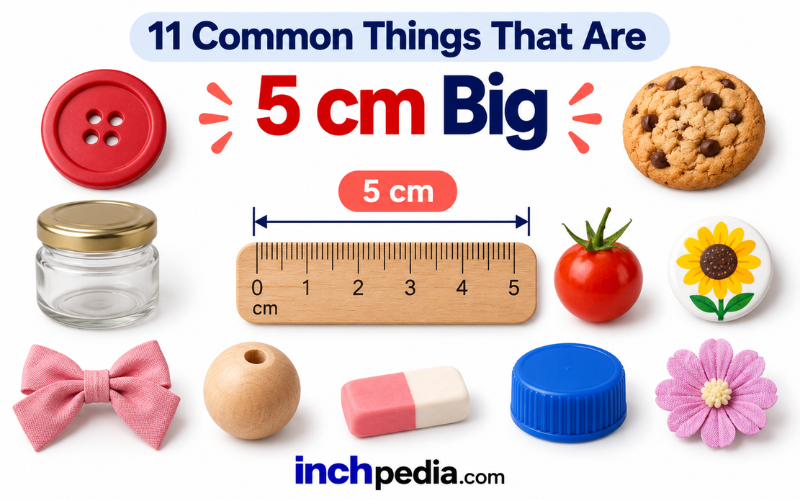
A measurement of 5 cm can describe the width, height, length, or diameter of an object. The dimension being measured matters. For example, a small decorative object might be 5 cm wide but only 2 cm tall, while another item could be 5 cm tall and considerably wider.
So, how big is 5 cm? Five centimeters equals 50 millimeters, 0.05 meters, and approximately 1.97 inches. In simple terms, 5 cm is just a little shorter than 2 inches.
There are plenty of everyday objects that can come close to this size. A large clothing button, small jar lid, craft flower, decorative badge, mini cookie, or large bead may provide a useful comparison. However, everyday objects are not manufactured or grown to one universal size, so these examples should be treated as approximate references rather than exact 5 cm measurements.
Below are 11 common things that can be around 5 cm in one dimension, followed by conversions, comparisons, measurement tips, practical uses, and answers to common questions about this size.
How Long Is 5 Centimeters?
5 Centimeters equals 5 cm or 1.97 inches.
Quick Answer
5 cm is 50 mm, 0.05 meters, and approximately 1.97 inches.
The easiest shortcut is to remember that 5 cm is almost 2 inches.
What Does 5 cm Look Like?
Five centimeters is a relatively short distance. It is small enough to fit easily across many small objects, but it is large enough to be noticeable when compared with a few-centimeter measurement.
On a standard metric ruler, the centimeter marks are clearly numbered. Starting from zero, you count:
1 cm → 2 cm → 3 cm → 4 cm → 5 cm
The fifth centimeter mark represents a total distance of 5 cm.
Another useful way to think about it is through millimeters. Each centimeter contains 10 millimeters, so:
5 cm = 5 × 10 = 50 mm
If you normally use inches, 5 cm is approximately 1.97 inches, which is very close to 2 inches.
In fact, 2 inches equals 5.08 cm. That means 5 cm is only 0.08 cm shorter than 2 inches.
5 cm in Inches
The exact conversion from centimeters to inches is based on the fact that 1 inch equals 2.54 centimeters.
To convert 5 cm:
5 ÷ 2.54 = 1.9685 inches
Rounded to two decimal places:
5 cm ≈ 1.97 inches
For everyday measurements, you can simply remember:
5 cm ≈ 2 inches
This shortcut is particularly useful when reading measurements on products that use centimeters even though you are more familiar with inches.
| Centimeters | Approximate Inches |
| 1 cm | 0.39 in |
| 2 cm | 0.79 in |
| 3 cm | 1.18 in |
| 4 cm | 1.57 in |
| 5 cm | 1.97 in |
| 6 cm | 2.36 in |
| 7 cm | 2.76 in |
| 8 cm | 3.15 in |
| 9 cm | 3.54 in |
| 10 cm | 3.94 in |
5 cm in Millimeters
Converting 5 cm to millimeters is straightforward.
There are 10 millimeters in 1 centimeter, so:
5 × 10 = 50 millimeters
Therefore:
5 cm = 50 mm
Millimeters are useful when dealing with smaller objects because they allow you to describe differences that may be difficult to express using whole centimeters.
For example:
- 5.0 cm = 50 mm
- 5.1 cm = 51 mm
- 5.2 cm = 52 mm
- 5.5 cm = 55 mm
- 6.0 cm = 60 mm
This makes millimeters useful for craft supplies, small hardware, jewelry components, product dimensions, and other compact objects.
5 cm in Meters
One meter contains 100 centimeters.
To convert 5 cm to meters:
5 ÷ 100 = 0.05 meters
Therefore:
5 cm = 0.05 m
This also means that 5 cm represents one-twentieth of a meter.
Another way to see the relationship is:
20 × 5 cm = 100 cm = 1 meter
So twenty sections measuring 5 cm each would span exactly one meter.
5 cm in Feet
One foot contains 30.48 centimeters.
Therefore:
5 ÷ 30.48 ≈ 0.164 feet
So:
5 cm ≈ 0.164 ft
Feet are not usually the most convenient unit for a measurement this small. Inches are much easier because 5 cm is almost exactly 2 inches.
11 Common Things That Are About 5 cm Big
The following objects can provide practical comparisons for a measurement of approximately 5 cm.
| Object | Approximate 5 cm Dimension |
| Large Clothing Button | Diameter |
| Small Drink Coaster | Width or diameter |
| Small Jar Lid | Diameter |
| Large Bottle Cap | Diameter |
| Mini Donut | Width |
| Small Craft Flower | Width |
| Decorative Badge | Diameter |
| Small Hair Bow | Width |
| Large Craft Bead | Diameter |
| Mini Cookie | Diameter |
| Small Measuring Cup | Width |
These objects can vary considerably depending on the manufacturer, material, recipe, or design. The examples are intended to give you practical size references.
1. Large Clothing Button
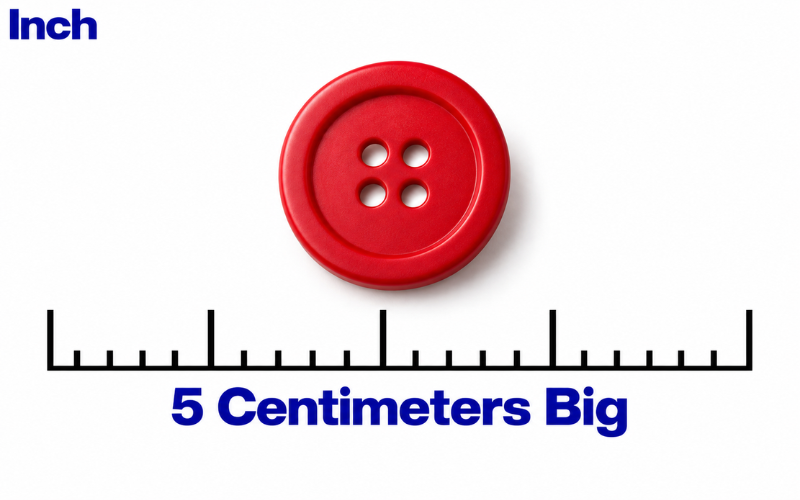
A large clothing button is one of the simplest objects to compare with 5 cm.
Buttons are produced in many sizes. The small buttons used on shirts are usually far smaller than 5 cm, while buttons made for coats, jackets, costumes, decorative clothing, and craft projects can be much larger.
A large button measuring around 5 cm across would have a diameter of almost 2 inches.
If you have one at home, place it flat on a ruler and measure from one outside edge to the opposite edge. For a circular button, make sure the ruler passes through the center. This gives you its approximate diameter.
A 5 cm button would look quite large compared with a standard shirt button. It could also be used as a decorative component in sewing or craft work.
Large buttons may be made from plastic, wood, metal, resin, shell-like materials, or other substances. Their thickness can vary, so a button that is 5 cm wide does not necessarily have a thickness anywhere near 5 cm.
This is an important distinction when using everyday objects as measurement references. The 5 cm measurement refers to one particular dimension, usually the width or diameter.
How to Measure a Button
To check whether a button is approximately 5 cm:
- Place the button on a flat surface.
- Put the 0 cm mark at one edge.
- Extend the ruler across the center.
- Read the measurement at the opposite edge.
If the opposite edge reaches close to the 5 cm mark, the button is approximately 5 cm across.
2. Small Drink Coaster
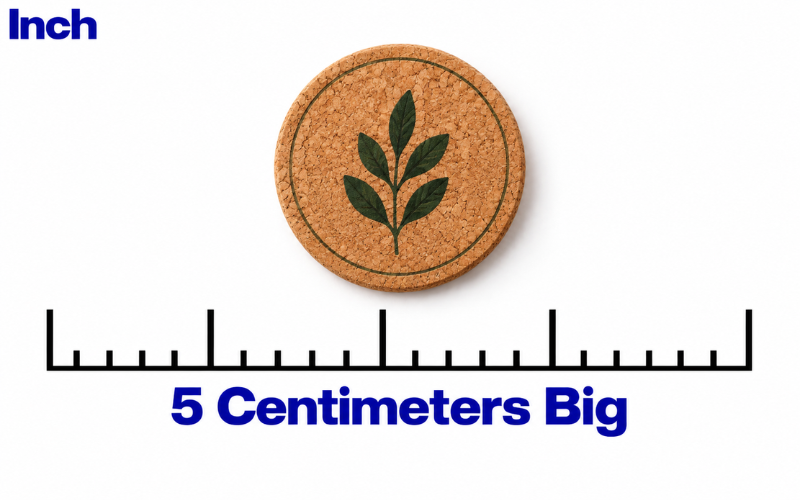
A small drink coaster can also provide a comparison for 5 cm, although ordinary full-size coasters are usually larger.
Miniature coasters, decorative coasters, coaster pieces used in crafts, and very small cup mats can sometimes measure around 5 cm in width or diameter.
A round coaster that measures approximately 5 cm across would be nearly 2 inches wide. That makes it a useful reference for people who are more comfortable thinking in inches.
When measuring a circular coaster, the most useful measurement is its diameter. Measure directly from one edge to the other while passing through the center.
For a square coaster, measure one side from edge to edge.
The thickness is a separate measurement and should not be confused with the width.
Why Coasters Make Useful Comparisons
A flat coaster gives you a simple, clearly defined dimension. Unlike an irregular object, its outer edges are easy to identify.
However, coaster sizes vary widely. A standard beverage coaster might be considerably larger than 5 cm, so it is better to specify small or miniature coaster when using this example.
3. Small Jar Lid
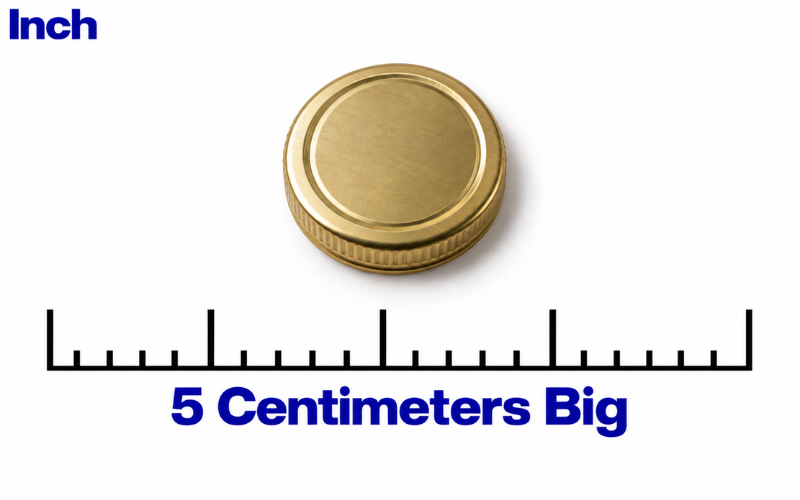
A small jar lid is another useful example of something that can measure close to 5 cm.
Small jars are used for spices, sauces, cosmetics, craft supplies, food products, samples, and household storage. Their lids come in different diameters, so some can be close to 5 cm.
If the lid measures approximately 5 cm from one outside edge to the opposite edge, it provides a straightforward example of the measurement.
The round shape also makes the size easy to check.
Place the lid flat on a ruler and measure across its center. Do not measure around the outside edge, because that would give you its circumference rather than its diameter.
Diameter vs. Circumference
This distinction is important.
If a jar lid is 5 cm across, 5 cm is its approximate diameter.
The distance around the outside edge would be much greater.
For a circle:
Circumference = π × diameter
So a circular object with a 5 cm diameter has a circumference of approximately:
3.1416 × 5 ≈ 15.7 cm
That means a 5 cm-wide round lid is about 15.7 cm around its edge.
4. Large Bottle Cap
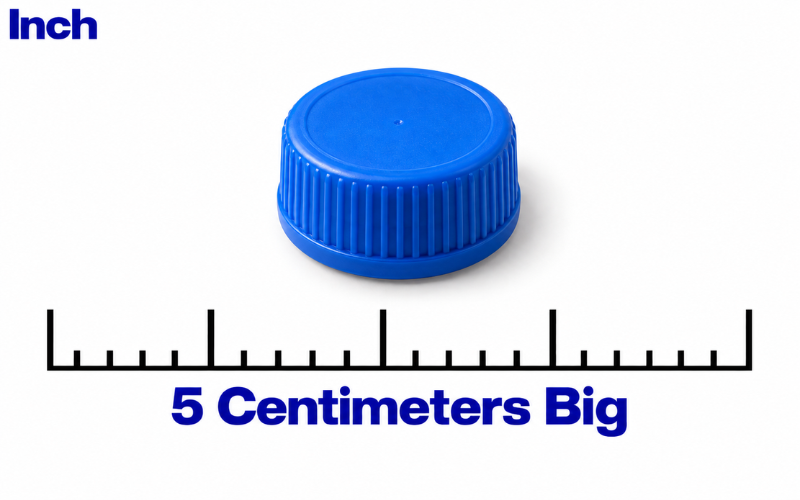
Bottle caps come in many sizes, and some larger caps can approach 5 cm across.
A typical small beverage bottle cap should not automatically be considered 5 cm. Many are noticeably smaller. However, caps from larger bottles, containers, household products, and specialty packaging may be closer to this measurement.
If you want to use a bottle cap as a 5 cm reference, measure it instead of estimating based on appearance.
Put the cap on a flat surface and measure across the widest part.
A cap that measures close to 5 cm provides a convenient small-object comparison because it has a clear circular shape.
Where Large Caps Are Found
Larger caps can be found on:
- Household containers
- Food jars
- Cleaning-product bottles
- Large beverage containers
- Cosmetic containers
- Storage containers
- Specialty packaging
Their exact dimensions depend on the container design.
5. Mini Donut
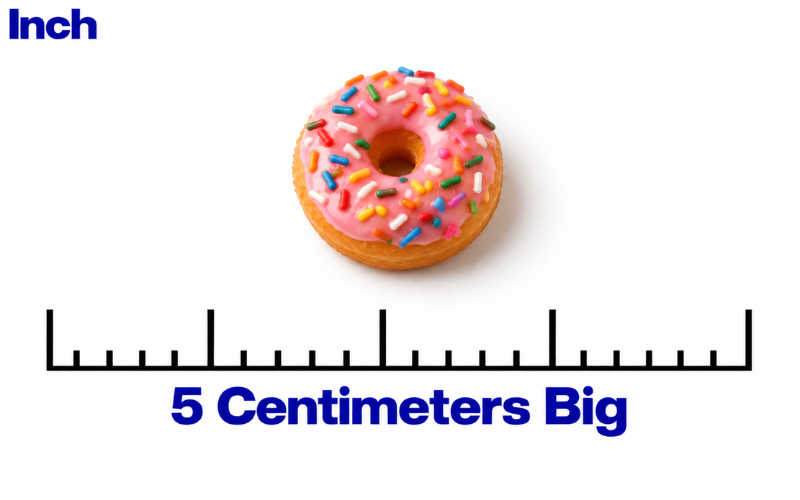
A mini donut can be around 5 cm across, depending on the bakery, recipe, or manufacturer.
A regular donut can be considerably larger, but miniature donuts are intentionally made in smaller sizes. Some may have an outside diameter close to 5 cm.
This makes a mini donut a useful food-based comparison.
If the donut measures 5 cm from one outside edge to the other, that is approximately:
1.97 inches
So a mini donut around 5 cm wide would be just under 2 inches across.
The size can change after baking because dough expands and spreads. For this reason, it is better to describe a mini donut as approximately 5 cm rather than saying every mini donut is exactly 5 cm.
Measuring a Donut
For a round donut, measure across the widest outside portion.
Do not measure the hole unless you specifically want the hole’s diameter.
The overall diameter and the diameter of the center opening are two different measurements.
6. Small Craft Flower
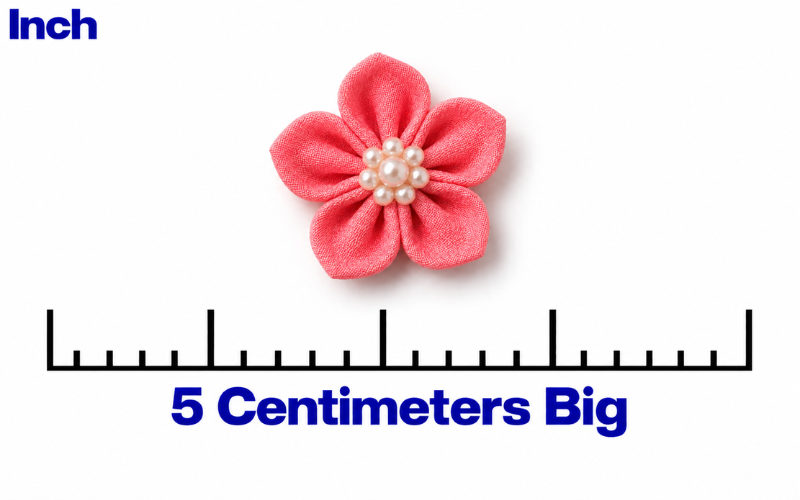
A small craft flower can be approximately 5 cm wide.
Artificial flowers and handmade craft flowers are available in many sizes. Small fabric, paper, foam, felt, or synthetic flowers may have an overall width around 5 cm.
A flower with a 5 cm span would be just under 2 inches from one outer petal to the opposite outer petal.
These flowers are commonly used for:
- Scrapbooking
- Gift wrapping
- Handmade cards
- Hair accessories
- Wreaths
- Decorative arrangements
- School projects
- DIY crafts
Because petals can bend, curl, or overlap, measuring a craft flower can produce different results depending on how it is positioned.
For a consistent measurement, place the flower flat and measure across its widest point.
7. Decorative Badge
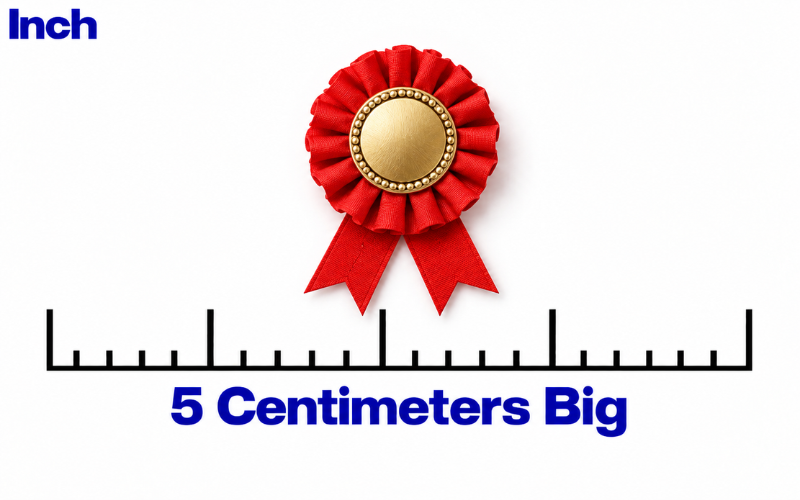
A decorative badge or large pin badge can be close to 5 cm in diameter.
Badges come in many sizes. Small badges can be only a few centimeters across, while larger decorative badges may approach 5 cm or more.
A round badge measuring approximately 5 cm across is almost the same as a 2-inch badge.
This makes it particularly useful as a comparison for people who use inches.
Badges are commonly attached to:
- Backpacks
- Jackets
- Clothing
- Hats
- Fabric bags
- Display boards
- Decorative collections
Measuring a Round Badge
Place the badge flat.
Measure from one outside edge through the center to the opposite outside edge.
If the ruler reaches approximately 5 cm, its diameter is close to 5 cm.
The pin, clasp, or fastening mechanism on the back should not be included if you are measuring the badge’s face.
8. Small Hair Bow
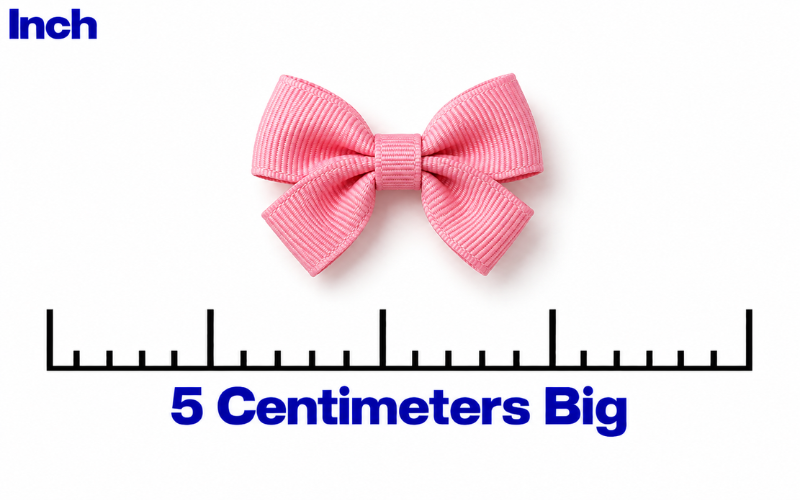
A small hair bow can measure around 5 cm wide.
Hair bows vary enormously in size. Some are tiny accessories, while others are large statement pieces. Small decorative bows can have an overall width close to 5 cm.
The relevant measurement is usually the width from one outer edge to the other.
A 5 cm bow is approximately 1.97 inches wide, so it is almost 2 inches across.
Fabric bows may be difficult to measure because they can flatten, fold, or change shape. If accuracy matters, place the bow gently on a flat surface without stretching it.
Other Uses for Small Bows
Bows around this size may also be used for:
- Gift decoration
- Doll clothing
- Craft projects
- Greeting cards
- Holiday decorations
- Hair accessories
- Clothing decoration
The actual size depends on the pattern and material.
9. Large Craft Bead
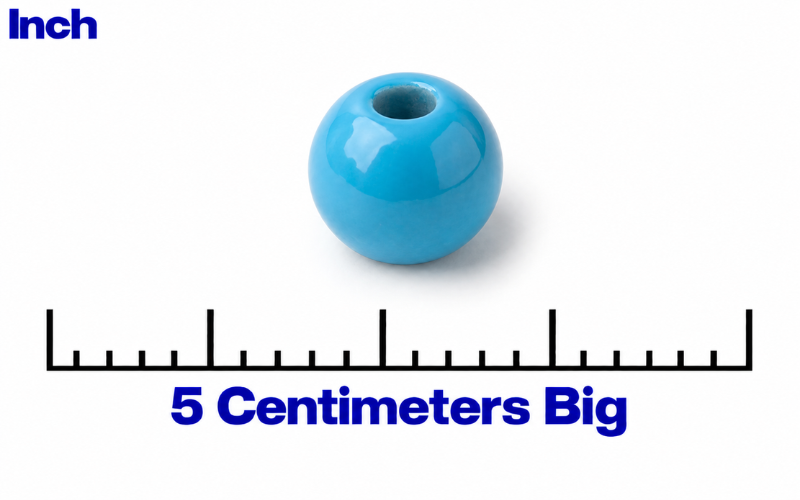
A large craft bead can be around 5 cm across.
Most beads used for necklaces and bracelets are much smaller than this. A bead with a diameter of approximately 5 cm would generally be considered oversized compared with ordinary jewelry beads.
Large beads are more likely to be used for:
- Decorative crafts
- Ornaments
- School projects
- Large jewelry pieces
- Home decorations
- Textile projects
- DIY displays
A spherical bead measuring 5 cm across has a diameter of approximately 1.97 inches.
If the bead has a central hole, the hole is not included when measuring the overall diameter.
How to Measure a Round Bead
Place the bead beside a ruler or use calipers if you need greater accuracy.
Measure across the widest section.
For a round bead:
Diameter ≈ 5 cm
Its circumference would be larger than 5 cm.
A 5 cm diameter sphere would have a circumference of approximately:
15.7 cm
This demonstrates why diameter and circumference should not be used interchangeably.
10. Mini Cookie
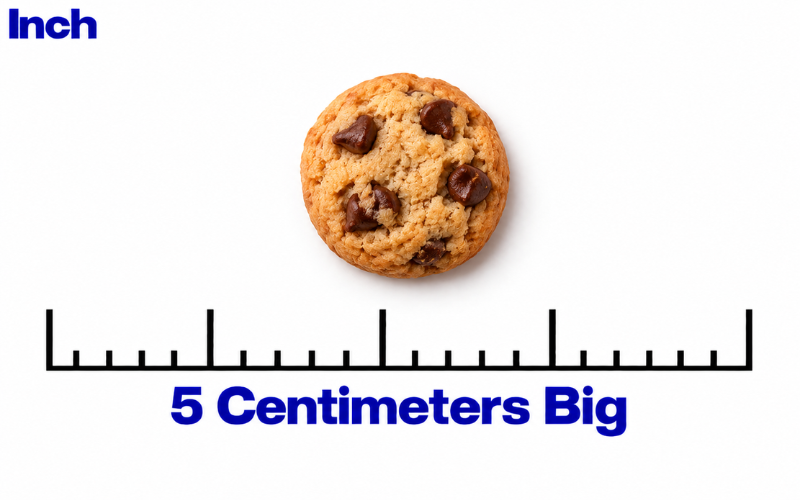
A mini cookie can have a diameter close to 5 cm.
Cookies are available in many shapes and sizes, so there is no single standard measurement. Small round cookies can sometimes be around 5 cm across.
A 5 cm cookie would be approximately 1.97 inches wide.
This makes it an easy food-related comparison because most people have seen cookies of different sizes.
The final diameter of a cookie depends on:
- The recipe
- Amount of dough used
- Baking temperature
- Baking time
- Dough consistency
- Manufacturing process
For that reason, the 5 cm figure should be considered an approximate comparison.
Measuring a Cookie
Place the cookie on a flat surface.
Measure across the widest part.
For a circular cookie, measuring through the center provides the diameter.
If the cookie is irregularly shaped, measure its maximum width rather than assuming it is perfectly circular.
11. Small Measuring Cup
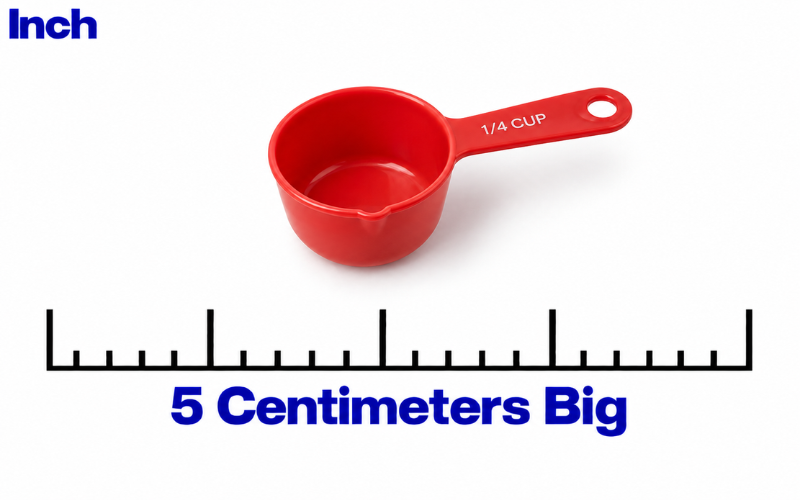
A small measuring cup can have a width close to 5 cm.
Small measuring containers are used for cooking, crafts, cosmetics, laboratory-style activities, household tasks, and other purposes.
The 5 cm measurement usually refers to the width or diameter of the container, not its height or liquid capacity.
For example, a small cup could be:
- Approximately 5 cm wide
- 4 cm tall
- Able to hold a small amount of liquid
That object would still qualify as an example of something that is 5 cm wide.
This shows why measurement descriptions should always specify the dimension being discussed.
Measuring the Cup
For a round cup, measure across its widest section.
If you are measuring the opening, measure from one inner or outer edge to the other depending on the specification you need.
For product measurements, always check whether the manufacturer lists inside diameter, outside diameter, height, width, or depth.
5 cm Compared With Other Small Measurements
Comparing 5 cm with nearby measurements makes its size easier to judge.
| Measurement | Difference From 5 cm |
| 1 cm | 4 cm shorter |
| 2 cm | 3 cm shorter |
| 3 cm | 2 cm shorter |
| 4 cm | 1 cm shorter |
| 5 cm | Reference |
| 6 cm | 1 cm longer |
| 7 cm | 2 cm longer |
| 8 cm | 3 cm longer |
| 9 cm | 4 cm longer |
| 10 cm | 5 cm longer |
The relationship becomes particularly simple at 10 cm:
5 cm is exactly half of 10 cm.
5 cm Compared With 1 cm
A 5 cm measurement is five times as long as 1 cm.
If you place five 1 cm sections end to end, the total length is:
1 + 1 + 1 + 1 + 1 = 5 cm
This is why a 5 cm object is noticeably larger than something that measures only 1 cm.
5 cm Compared With 2 cm
Five centimeters is 2.5 times longer than 2 cm.
Two 2 cm sections make 4 cm. Adding another 1 cm produces 5 cm.
So:
2 cm + 2 cm + 1 cm = 5 cm
This is a useful comparison when working with small craft items or other compact objects.
5 cm Compared With 3 cm
The difference between 3 cm and 5 cm is:
5 − 3 = 2 cm
A 5 cm object is therefore 2 cm longer across the measured dimension than a 3 cm object.
This difference may look small numerically, but it can be noticeable when measuring compact objects.
5 cm Compared With 4 cm
A 5 cm measurement is exactly 1 cm longer than 4 cm.
If an object measures 4 cm and another measures 5 cm, the second object is 25% longer than the first.
That difference can matter when choosing components that need to fit within a specific space.
5 cm Compared With 10 cm
This is one of the easiest comparisons.
5 cm is exactly half of 10 cm.
If you have a ruler, look at the section between 0 and 10 cm. The halfway point is 5 cm.
Therefore:
10 cm ÷ 2 = 5 cm
If you can picture 10 cm, simply imagine half of that distance to get a rough idea of 5 cm.
5 cm Compared With 15 cm
A 15 cm distance is three times 5 cm.
5 × 3 = 15 cm
A common 15 cm ruler therefore contains three sections of 5 cm.
This can be useful when estimating the dimensions of small objects using a standard school ruler.
5 cm Compared With 20 cm
A 20 cm measurement contains four sections of 5 cm.
5 × 4 = 20 cm
So if you know what 20 cm looks like, divide that distance into four equal parts to estimate 5 cm.
5 cm Compared With 1 Meter
One meter equals 100 cm.
Therefore:
100 ÷ 5 = 20
Exactly 20 sections of 5 cm fit into 1 meter.
This places the measurement into perspective. Five centimeters is only one-twentieth of a meter.
How to Measure Exactly 5 cm
The most reliable way to measure 5 cm is with a metric ruler.
Start by placing the edge of the object at the ruler’s 0 cm mark. Then extend the ruler along the dimension you want to measure.
If the other edge reaches the 5 cm mark, the measured distance is exactly 5 cm.
For better accuracy:
- Keep the ruler straight.
- Start from zero rather than the ruler’s physical edge.
- Measure along the correct dimension.
- Use millimeter marks when necessary.
- Keep curved objects positioned consistently.
- Check the measurement twice.
A standard ruler is generally sufficient for ordinary 5 cm measurements.
You can compare this measurement with other measurements like 2 cm, 3 cm.
What if the Object Starts at 1 cm?
A common measuring mistake occurs when someone starts at the 1 cm mark rather than zero.
Suppose one edge of an object starts at 1 cm and the other edge reaches 6 cm.
The object is not 6 cm long.
The actual measurement is:
6 − 1 = 5 cm
This is why the difference between the two ruler readings matters.
Starting from zero makes the calculation easier, but subtracting the starting position also gives the correct result.
How Many Millimeters Are Between 0 and 5 cm?
There are 50 millimeters between 0 cm and 5 cm.
Each centimeter contains 10 millimeters:
- 0–1 cm = 10 mm
- 1–2 cm = 10 mm
- 2–3 cm = 10 mm
- 3–4 cm = 10 mm
- 4–5 cm = 10 mm
Adding them gives:
10 + 10 + 10 + 10 + 10 = 50 mm
Is 5 cm the Same as 2 Inches?
Not exactly, but it is very close.
2 inches = 5.08 cm
Meanwhile:
5 cm = 1.9685 inches
The difference between 5 cm and 2 inches is only 0.08 cm, which equals 0.8 mm.
So for rough everyday estimating, you can safely think of 5 cm as almost 2 inches.
For technical, engineering, medical, manufacturing, or other precision work, use the exact conversion instead.
Is 5 cm Big or Small?
In most everyday situations, 5 cm is a small measurement.
It is large enough to describe a button, badge, bead, cookie, or small decorative object, but much smaller than common household items such as plates, books, bottles, or phones.
The word “big” also depends on what is being measured.
For example:
- A 5 cm button is relatively large for a clothing button.
- A 5 cm bead is very large compared with a typical jewelry bead.
- A 5 cm cookie is small compared with some bakery cookies.
- A 5 cm ruler section is simply a short distance.
- A 5 cm container width may be considered small.
Therefore, the measurement itself stays the same even when the object’s size seems different in context.
Can You Estimate 5 cm Without a Ruler?
Yes, but only approximately.
Since 5 cm is nearly 2 inches, people familiar with inches can use 2 inches as a rough reference.
Another approach is to compare the distance with a familiar object whose size is known. However, this method is less reliable because everyday objects differ in size.
For example, not every button, coin, bead, or bottle cap has the same dimensions.
If accuracy matters, a ruler is much better than estimation.
Using Your Hand as a Rough Reference
Your hand can provide a rough reference for small measurements, but it should not be treated as an exact measuring instrument.
Finger widths differ from person to person, so saying that 5 cm is exactly equal to a certain part of someone’s finger would be inaccurate.
For a quick estimate, however, you may compare a small object with the width of a finger or part of the hand.
For anything requiring a precise measurement, use an actual measuring tool.
Measuring Round Objects That Are 5 cm Across
When a round object is described as 5 cm big, the measurement often refers to its diameter.
The diameter is the straight distance from one side of a circle through the center to the opposite side.
Examples include:
- Buttons
- Jar lids
- Badges
- Beads
- Cookies
- Small caps
If the diameter is approximately 5 cm, the object is approximately 1.97 inches across.
Do not confuse diameter with circumference.
A circular object with a 5 cm diameter would have a circumference of roughly 15.7 cm.
Measuring Irregular Objects
Some objects do not have a perfect circular or rectangular shape.
For an irregular object, decide what dimension you want before measuring.
You might measure:
- Maximum width
- Maximum height
- Overall length
- Thickness
- Distance between two specific points
For example, a craft flower might be described as 5 cm wide from the tip of one petal to the opposite petal.
A hair bow might be 5 cm wide but only 3 cm tall.
Both measurements can be correct because they refer to different dimensions.
Why Approximate Measurements Matter
Everyday objects rarely have perfectly fixed dimensions.
A natural food item can vary from one piece to another. Manufactured products can also differ by model, brand, and design.
For example, one mini cookie might be 4.8 cm wide while another is 5.2 cm wide.
Both could reasonably be described as around 5 cm.
The word “about” or “approximately” is therefore important when using everyday objects as size references.
If a product specification says an item is exactly 5.00 cm, that is different from saying an object is approximately 5 cm.
5 cm in Everyday Shopping
Measurements become especially useful when shopping online.
Product descriptions often use centimeters to describe:
- Jewelry
- Accessories
- Storage containers
- Decorations
- Craft supplies
- Kitchen equipment
- Phone accessories
- Clothing accessories
- Children’s items
- Small tools
If a listing says an object is 5 cm wide, you can convert that to approximately 1.97 inches.
This makes it easier to compare products that use different measurement systems.
Before purchasing, check whether the listed measurement refers to length, width, height, diameter, depth, or thickness.
5 cm for Craft Projects
Five centimeters is a practical size in many craft activities.
Craft materials may be sold in dimensions such as:
- 2 cm
- 3 cm
- 4 cm
- 5 cm
- 6 cm
- 10 cm
A 5 cm piece can be used for decorative flowers, buttons, beads, bows, paper shapes, embellishments, and small ornaments.
When planning a project, measure the available space first. A decorative component described as 5 cm wide may need slightly more room if it has curved edges or protruding parts.
5 cm in Sewing
Sewing projects often involve small measurements.
A 5 cm measurement may be relevant to:
- Button diameter
- Bow width
- Patch dimensions
- Decorative trim
- Fabric spacing
- Small appliqués
- Pocket details
When working with fabric, measurements can shift if the material stretches.
For accurate sewing, mark the fabric with a ruler rather than relying on an approximate object as a guide.
5 cm in Cooking and Baking
Five centimeters can be useful for describing small food items.
Examples include:
- Mini cookies
- Small pastries
- Mini donuts
- Food decorations
- Small pieces of fruit
- Small baked items
Food sizes vary, so a recipe should specify whether the measurement refers to diameter, width, length, or thickness.
For example, “make cookies 5 cm wide” means the cookies should have an approximate diameter or width of 5 cm.
It does not mean the cookies should be 5 cm thick.
5 cm in Home Organization
Small containers and lids often have dimensions measured in centimeters.
A 5 cm-wide container can be useful for:
- Small craft materials
- Jewelry
- Screws
- Buttons
- Beads
- Clips
- Small accessories
Knowing the dimensions before buying storage containers can prevent problems with fitting items into a particular drawer, shelf, or organizer.
5 cm in Product Dimensions
When a product is listed as 5 cm, always check the complete specification.
For example:
5 cm × 5 cm × 3 cm
means the object has three different dimensions.
The first 5 cm could be its length, while the second 5 cm could be its width. The 3 cm could represent height or depth.
A single “5 cm” measurement does not automatically describe the entire size of an object.
Common Mistakes When Measuring 5 cm
Several simple mistakes can lead to incorrect results.
Starting From the Wrong Point
If you begin at 1 cm instead of zero, remember to subtract the starting reading.
Measuring Around a Circle
Measuring around a round object gives circumference, not diameter.
Measuring the Wrong Dimension
A product may be 5 cm wide but 8 cm tall. Make sure you measure the dimension you actually need.
Holding the Ruler at an Angle
A ruler should normally be aligned directly with the dimension being measured.
Ignoring Millimeters
If an object measures 5.4 cm, it is not exactly 5 cm. The additional 4 mm matters when precision is required.
Assuming Every Similar Object Has the Same Size
Two bottle caps, cookies, buttons, or beads can have different dimensions even when they look similar.
A Simple 5 cm Reference Table
Here is a quick list of the main conversions to keep nearby:
| Unit | 5 cm Equivalent |
| Millimeters | 50 mm |
| Centimeters | 5 cm |
| Meters | 0.05 m |
| Inches | 1.97 in |
| Feet | 0.164 ft |
| Yards | 0.0547 yd |
The most useful two values to remember are:
5 cm = 50 mm
and
5 cm ≈ 1.97 inches
How Many 5 cm Pieces Make 10 cm?
Two pieces of 5 cm make 10 cm.
5 + 5 = 10 cm
Therefore:
10 ÷ 5 = 2
There are exactly 2 sections of 5 cm in 10 cm.
How Many 5 cm Pieces Make 15 cm?
Three sections are needed:
5 + 5 + 5 = 15 cm
Therefore:
15 ÷ 5 = 3
So there are exactly 3 sections of 5 cm in 15 cm.
How Many 5 cm Pieces Make 25 cm?
Five sections make 25 cm:
5 × 5 = 25 cm
Therefore, a 25 cm distance can be divided into five equal sections of 5 cm.
How Many 5 cm Pieces Make 50 cm?
Ten sections make 50 cm:
5 × 10 = 50 cm
So 10 sections of 5 cm equal half a meter.
How Many 5 cm Pieces Make 1 Meter?
One meter is 100 cm.
100 ÷ 5 = 20
Therefore, exactly 20 sections of 5 cm make 1 meter.
This is a useful mathematical reference when working with larger measurements.
How Many 5 cm Pieces Make 1 Foot?
One foot equals 30.48 cm.
Dividing by 5:
30.48 ÷ 5 = 6.096
So approximately 6.1 sections of 5 cm equal one foot.
Six sections equal 30 cm, which is slightly shorter than one foot by 0.48 cm.
5 cm and 50 mm Are the Same Measurement
Some people may see 50 mm and assume it is different from 5 cm.
It is not.
Because 10 mm equals 1 cm:
50 mm ÷ 10 = 5 cm
Therefore:
50 mm = 5 cm
The units are different, but the physical distance is exactly the same.
Is 5 cm Half of 1 Inch?
No.
One inch equals 2.54 cm.
Half an inch equals:
2.54 ÷ 2 = 1.27 cm
So 5 cm is much longer than half an inch.
Instead, 5 cm is almost equal to 2 inches.
Is 5 cm Half of 1 Foot?
No.
One foot is 30.48 cm.
Half a foot is:
30.48 ÷ 2 = 15.24 cm
So 5 cm is considerably shorter than half a foot.
Five centimeters is approximately one-sixth of a foot.
Is 5 cm One-Fifth of a Meter?
Yes.
One meter equals 100 cm.
Five centimeters is:
5 ÷ 100 = 0.05
That is one-twentieth of a meter, not one-fifth.
One-fifth of a meter would be:
100 ÷ 5 = 20 cm
So:
5 cm = 1/20 meter
and
20 cm = 1/5 meter
Can 5 cm Be Measured With a Phone?
A phone’s screen or camera can sometimes be used with a measuring application, but the result may not be perfectly accurate without calibration.
For a quick estimate, a digital measuring tool can be convenient.
For precision, especially when an object needs to fit a specific space, a physical ruler or measuring tape is preferable.
Why 5 cm Is a Useful Measurement
Five centimeters sits in a convenient range for small measurements.
It is:
- Easy to mark on a ruler
- Almost 2 inches
- Exactly 50 mm
- Half of 10 cm
- One-twentieth of a meter
- Large enough for many small objects
- Small enough for detailed measurements
This makes it common in crafts, packaging, accessories, household items, and product specifications.
If it is helpful for you and want more free guides then here we have more for you:
- 10 Common Things That Are 9 cm Big
- 11 Common Things That Are 2 Centimeters Big
- 11 Common Things That Are 3 Centimeters Big
FAQs
How big is 5 cm?
5 cm is equal to 50 mm, 0.05 meters, and approximately 1.97 inches. It is almost exactly 2 inches, making it a relatively small measurement.
What common things are about 5 cm big?
Examples include a large clothing button, small jar lid, large bottle cap, mini donut, small craft flower, decorative badge, small hair bow, large craft bead, mini cookie, and small measuring cup. Actual dimensions vary by object.
Is 5 cm the same as 2 inches?
Not exactly. 2 inches equals 5.08 cm, while 5 cm equals approximately 1.97 inches. The difference is only 0.08 cm, so the two measurements are very close.
How many millimeters are in 5 cm?
There are 50 millimeters in 5 centimeters. Since 1 centimeter contains 10 millimeters, multiplying 5 by 10 gives 50 mm.
How can I measure 5 cm accurately?
Use a metric ruler and place one edge of the object at the 0 cm mark. Measure to the opposite edge and check whether it reaches the 5 cm mark. For greater precision, use the millimeter markings.
Conclusion
5 centimeters is a small but useful measurement that equals 50 millimeters and approximately 1.97 inches. Because it is almost the same as 2 inches, it is relatively easy to estimate once you know the conversion.
A number such as 5 cm becomes more practical when compared with familiar objects. A large clothing button, small jar lid, decorative badge, craft flower, mini cookie, large bead, or small container can all provide examples of objects that may have a dimension close to 5 cm.
The key point is that these objects are approximate comparisons. Their actual sizes depend on their design, manufacturer, variety, or natural variation. A 5 cm button may be wider than another button, and one mini cookie may be larger than another.
For an exact measurement, use a ruler and check the distance from the 0 cm mark to the 5 cm mark. If you prefer inches, remember the simple shortcut:
5 cm ≈ 2 inches.
That one conversion makes 5 cm much easier to recognize when reading measurements on products, working on crafts, measuring household objects, or comparing the size of small everyday items.
For More Measurements Visit: Inchpedia